In multiple fields such as water treatment, chemical separation, and environmental governance, ion exchange technology has become one of the core technologies due to its efficient, precise, and reversible ion separation capabilities. Through simple physical and chemical reactions, it achieves selective separation, removal, and purification of ions in solutions, breaking the limitations of traditional filtration and precipitation technologies that struggle to precisely separate trace ions. Especially in the field of water treatment, it is a core means to solve key problems such as hard water softening, pure water preparation, and wastewater purification. It is widely used in scenarios including domestic drinking water treatment, industrial production water purification, deep treatment of industrial wastewater, and water resource reuse.
I. Core Principles of Ion Exchange
The essence of ion exchange is a reversible, equivalent displacement reaction. The core is the mutual replacement process between exchangeable ions on the surface of an insoluble solid substance (ion exchanger) and ions of the same charge in the solution. This process is based on the combined action of electrostatic interactions, ion hydration, and van der Waals forces, adhering to two core principles which form the basis of its wide application.
First is the Principle of Electrical Neutrality, which is the basic premise of the ion exchange reaction. The total charge of the solution and the ion exchanger remains balanced before and after the exchange. The total charge of ions adsorbed on the surface of the ion exchanger is exactly equal to the total charge of exchangeable ions released into the solution. For example, one divalent cation (such as Ca²⁺, Mg²⁺) will displace two monovalent cations (such as Na⁺, H⁺), and one divalent anion (such as SO₄²⁻) will displace two monovalent anions (such as Cl⁻, OH⁻). This principle determines the reaction ratio of ion exchange and provides a theoretical basis for calculating exchange capacity and determining regenerant dosage.

Second is the Principle of Reversibility. The ion exchange reaction is a dynamic equilibrium reaction. When the concentration of impurity ions in the solution is high and the concentration of exchangeable ions in the exchanger is low, the reaction proceeds forward: impurity ions are adsorbed, and exchangeable ions enter the solution. When the concentration of impurity ions decreases and the concentration of another ion of the same charge (such as ions in the regenerant) increases, the reaction proceeds in reverse: impurity ions are displaced, and the exchanger restores its state. This is the theoretical basis for exchanger regeneration and reuse, giving ion exchange technology the advantage of being economic and efficient.
The driving force of ion exchange comes from electrostatic attraction and concentration differences: opposite charges attract, causing impurity ions to be adsorbed by the exchanger, while concentration differences drive ions to migrate from high to low concentrations, promoting the reaction until dynamic equilibrium is reached. At equilibrium, the distribution ratio of exchangeable ions on the exchanger surface to ions in the solution is closely related to ion type, concentration, temperature, and exchanger characteristics.
Ion selectivity is an important feature that determines the feasibility of precise separation. It mainly depends on the ion's charge number, ionic radius, and hydrated radius, following three major laws:
1. The higher the charge number, the stronger the selectivity (divalent > monovalent, trivalent > divalent).
2. When charge numbers are the same, the smaller the ionic radius and the larger the hydrated radius, the stronger the selectivity (e.g., Li⁺ > Na⁺ > K⁺).
3. For the same ion, selectivity varies depending on the type of exchanger (e.g., weakly acidic cation resins have higher selectivity for H⁺ than strongly acidic resins). This selectivity makes targeted impurity removal in water treatment possible, such as preferentially removing Ca²⁺ and Mg²⁺ in hard water softening.
The rate of the ion exchange reaction affects application effectiveness and depends on three steps: diffusion of impurity ions from the solution to the exchanger surface (film diffusion), diffusion of impurity ions into the internal pores of the exchanger towards active groups (internal diffusion), and the displacement reaction between ions (chemical exchange). Internal diffusion is the key rate-limiting step. Factors affecting the rate include solution flow rate, temperature, ion concentration, and exchanger particle size. In practical applications, these parameters must be reasonably controlled to achieve optimal results.
II. How Ion Exchange Resins Utilize the Ion Exchange Principle
Ion exchange resin is the most commonly used ion exchanger. It is essentially an insoluble high-molecular polymer with a three-dimensional network structure. Compared to natural exchangers (such as zeolites and bentonite), it offers advantages including large exchange capacity, strong selectivity, high mechanical strength, good regeneration performance, and long service life, making it widely used in various fields. Its structure consists of two parts: an inert high-molecular skeleton and active functional groups connected to the skeleton, which work together to achieve ion exchange functions.
The high-molecular skeleton is the foundation of the resin, serving to support and fix the active functional groups. It is insoluble in water and most organic solvents. Its materials mainly include styrene series, acrylic series, and phenolic series. Among these, styrene series resins are the most widely used (accounting for over 80%), formed by the polymerization of styrene and divinylbenzene, where divinylbenzene acts as a cross-linking agent to form a three-dimensional network structure. Cross-linking degree (divinylbenzene content) is a key indicator: higher cross-linking results in greater mechanical strength, lower porosity, and slower ion diffusion; lower cross-linking results in weaker mechanical strength, higher porosity, and faster ion diffusion. In practical applications, resins with different cross-linking degrees can be selected based on needs.
Active functional groups are the core of ion exchange. Their ends carry freely mobile exchangeable ions that can undergo displacement reactions with impurity ions of the same charge in the solution. Based on the nature of the active groups, resins can be classified into cation, anion, chelating, and amphoteric types. Among these, cation and anion exchange resins are the two most commonly used in water treatment and are often used in combination to achieve comprehensive impurity removal.
Cation exchange resins have acidic active groups, divided into strong acid and weak acid types:
· Strong acid resins (active group is sulfonic acid group -SO₃H) have strong acidity and can ionize H⁺ at any pH value. They can exchange all cations. While the exchange is stable, regeneration is difficult, typically requiring high-concentration HCl or NaCl solutions.
· Weak acid resins (active groups include carboxyl group -COOH, etc.) have weak acidity and only ionize H⁺ in neutral or alkaline solutions. They mainly exchange divalent cations. Their exchange capacity is greatly affected by pH, but they are easier to regenerate, often using dilute HCl or dilute sulfuric acid. Process: When a solution containing cationic impurities (such as Ca²⁺, Mg²⁺, Fe³⁺) flows through the resin column, impurity cations undergo same-charge displacement with exchangeable ions (H⁺ or Na⁺) on the resin. The resin preferentially adsorbs cations with stronger selectivity until equilibrium is reached. For example, sodium-type cation resins are used for hard water softening (displacing Ca²⁺ and Mg²⁺ with Na⁺), while hydrogen-type cation resins are used for pure water preparation (displacing all cations with H⁺).
Anion exchange resins have basic active groups, divided into strong base and weak base types:
· Strong base resins (active group is quaternary ammonium group -N(CH₃)₃OH) have strong alkalinity and can ionize OH⁻ at any pH value. They can exchange all anions. The exchange is stable, and regeneration typically uses high-concentration NaOH solutions.
· Weak base resins (active groups include amino groups, etc.) have weak alkalinity and only ionize OH⁻ in acidic solutions. They mainly exchange strong acid radical anions. Their exchange capacity is greatly affected by pH, but they are easier to regenerate, often using dilute NaOH or dilute ammonia water. Process: Similar to cation resins, when a solution containing anionic impurities (such as Cl⁻, SO₄²⁻, NO₃⁻) flows through the resin column, impurity anions undergo same-charge displacement with exchangeable ions (OH⁻ or Cl⁻) on the resin, preferentially adsorbing anions with stronger selectivity until equilibrium. For example, hydroxyl-type anion resins are used for pure water preparation (displacing all anions with OH⁻). The released OH⁻ combines with H⁺ released by cation resins to form water, achieving deep deionization.
The exchange capacity of ion exchange resins is limited, categorized into total exchange capacity (an inherent property of the resin), working exchange capacity (effective exchange amount in practical application, lower than total capacity), and regeneration exchange capacity (capacity restored after regeneration, typically 70%-90% of total capacity). When all exchangeable ions on the resin are displaced, regeneration is required to restore capacity.
The specific regeneration process involves: Passing a high-concentration regenerant through the saturated resin. The high concentration of regenerant ions drives the exchange reaction in reverse, displacing the adsorbed impurity ions and restoring the resin's exchangeability. Regeneration effectiveness is affected by regenerant concentration, flow rate, temperature, and time, requiring reasonable parameter control: excessively high concentration can damage the resin structure, while too low leads to incomplete regeneration; too fast flow rate results in insufficient contact time, and excessive temperature accelerates resin aging.
During use, resins must be protected from contamination and aging:
· Contamination mainly includes organic contamination (blocking anion resin pores), heavy metal contamination (making cation resins difficult to regenerate), and suspended solid contamination (blocking resin gaps). Pre-treatment devices (filtration, activated carbon adsorption, etc.) must be installed before the exchange system.
· Aging refers to structural damage and decreased exchange capacity caused by oxidation and degradation during long-term use. Usage conditions must be controlled to avoid extreme environments.
III. Applications of Ion Exchange in Water Treatment
Water treatment is the most widespread and mature field for ion exchange technology. Based on water treatment needs, main applications are divided into three categories: hard water softening, pure/ultra-pure water preparation, and wastewater treatment/reuse, each with clear process designs and operational points.
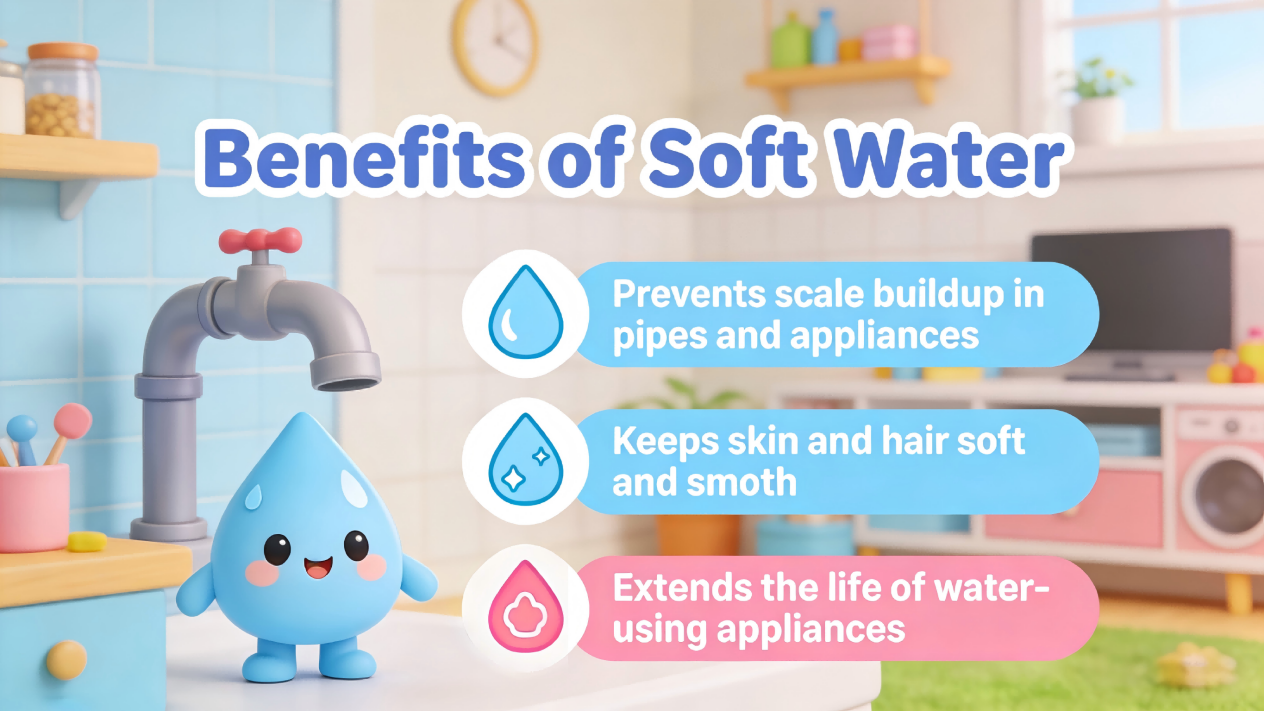
(I) Hard Water Softening Hard water contains high levels of Ca²⁺ and Mg²⁺. Long-term use leads to scale deposition, pipe blockage, reduced thermal efficiency, and affects detergent effectiveness. Therefore, hard water softening is a crucial link in domestic and industrial water treatment, with ion exchange being the most common method. This application mainly uses sodium-type cation exchange resins, utilizing Na⁺ on the resin to displace Ca²⁺ and Mg²⁺ in the water. Reaction equations: 2R-Na + Ca²⁺ ⇌ R₂-Ca + 2Na⁺, 2R-Na + Mg²⁺ ⇌ R₂-Mg + 2Na⁺. After the reaction, Ca²⁺ and Mg²⁺ are adsorbed by the resin, and Na⁺ concentration in the water slightly increases without forming scale, achieving softening. In practice, the system consists of resin columns, regeneration devices, and control systems. Raw water enters the resin column after pre-treatment to remove suspended solids. When the resin is saturated, it is regenerated using a 10%-15% NaCl solution. The process is simple with stable effects, controlling outlet hardness below 0.03mmol/L. It is widely used in residential areas, hotels, hospitals, and boiler water systems.
(II) Pure and Ultra-Pure Water Preparation Industries like electronics, medicine, chemicals, and semiconductors require water with almost all ionic impurities removed. Ion exchange is a core technology, often using a "cation exchange resin + anion exchange resin" composite bed system, sometimes adding a mixed bed column. Core Process: After pre-treatment, raw water first flows through the cation exchange column where all cations are adsorbed and H⁺ is released. Then, the water flows through the anion exchange column where all anions are adsorbed and OH⁻ is released. H⁺ and OH⁻ combine to form water, achieving deep ion removal. For ultra-pure water, a mixed bed column (mixing hydrogen-type cation and hydroxyl-type anion resins) is added after the composite bed to further remove trace ions, reaching conductivity standards ≤0.1μS/cm. Some systems also combine with reverse osmosis ("RO + Ion Exchange") to improve efficiency and reduce regeneration frequency. This method ensures stable, high-purity water quality essential for chip manufacturing and pharmaceutical injections.
(III) Wastewater Treatment and Reuse Industrial and domestic wastewater often contain harmful ions like heavy metals, nitrates, and fluorides. Ion exchange enables selective removal of these ions while allowing water reuse.
· Heavy Metal Wastewater: Uses chelating cation exchange resins to selectively adsorb Cu²⁺, Ni²⁺, Pb²⁺, Cr³⁺, etc. After saturation, acids are used for regeneration, allowing recovery of heavy metals for recycling while meeting discharge standards. This is effective for electroplating wastewater.
· Nitrate and Fluoride Wastewater: Uses anion exchange resins to selectively adsorb NO₃⁻ and F⁻, preventing groundwater pollution and health hazards. Additionally, it treats ammonia-nitrogen wastewater (adsorbing NH₄⁺) and dyeing wastewater (adsorbing dye ions and heavy metals), achieving purification and reuse.
IV. Improvement of Life by Ion Exchange Technology
(I) Improvements to Daily Life Ion exchange technology improves life primarily through enhanced water quality, reduced living costs, environmental friendliness, and health protection.
· Household: Softening hard water prevents scale in faucets, showers, and heaters, improving aesthetics and efficiency. It makes laundry softer, prevents yellowing, and improves skin comfort by avoiding soap scum.
· Public Scenarios: Ensures quality water supply in residences, hotels, and hospitals. In sewage treatment, it removes harmful ions for reuse, reducing waste and pollution. It also improves drinking water taste through softening and purification.
(II) Core Advantages
1. High Efficiency and Precision: Targets specific ions (like calcium, magnesium, heavy metals) that traditional methods miss, ensuring stable water quality.
2. Convenient Operation and Maintenance: Home softeners run automatically; users only need to periodically replenish regenerant (salt). No frequent professional maintenance is needed.
3. Regenerable and Economic: Resins can be regenerated repeatedly, significantly lowering long-term costs compared to disposable filters.
4. Wide Adaptability: Can be adjusted for different water qualities and needs, suitable for various scenarios and combinable with other technologies like RO.
5. Environmentally Friendly: Produces no toxic gases or solid waste; regenerant waste has minimal environmental impact, and water reuse conserves resources.
(III) Main Disadvantages
1. Increased Sodium Content: Home softeners (sodium-type) replace calcium/magnesium with sodium, leading to excessive sodium levels unsuitable for drinking. Long-term consumption may increase risks for those with hypertension, kidney, or heart diseases. Softened water is strictly for household use (laundry, bathing), not drinking.
2. Regeneration Inconvenience: Requires regular salt replenishment. Forgotten refills lead to loss of softening capability. Regeneration produces salty wastewater which, if improperly handled, might corrode old pipes.
3. Limited Contaminant Removal: Cannot remove organic matter, bacteria, or viruses. Must be paired with activated carbon or RO for safe drinking water.
4. Aging and Contamination: Suspended solids and organics in raw water can foul or age the resin, shortening lifespan and requiring replacement.
(IV) Usage Precautions
1. Clarify Water Usage: Softened water is only for household non-drinking purposes. Install separate drinking water purification equipment (e.g., RO) for drinking.
2. Regular Maintenance: Timely replenish regenerant, clean resin periodically to prevent fouling/aging, and properly dispose of regeneration wastewater.
V. About UMEK
In the field of water treatment, AMANDA (UMEK), with profound industry accumulation, has become a professional brand combining technical strength and market reputation. With 29 years of experience in the water treatment industry, it focuses on the R&D, production, and supply of ion exchange resins, precisely adapting to home and industrial core scenarios to provide high-quality products and solutions globally.
· Home Scenario: AMANDA (UMEK) offers specialized home softening resins perfectly adapted to home softeners. Made from high-quality raw materials, these resins feature large exchange capacity, good regeneration performance, and long service life. They efficiently displace scale-forming ions (Ca²⁺, Mg²⁺), solving issues like scale deposition, stiff laundry, and dry skin. Regeneration is convenient (just add salt), balancing practicality and economy while ensuring water meets household standards.
· Industrial Scenario: Leveraging years of technical accumulation, AMANDA (UMEK) provides diversified industrial-grade resins for pure water preparation, wastewater treatment, and boiler water softening. A core product is the industrial mixed bed resin, composed of gel-type strong acid cation and strong base anion resins mixed in specific chemical equivalents. After high-level transformation and special purification, it is directly used for deep water purification in electronics, medicine, chemicals, and semiconductors. It efficiently removes various ionic impurities to meet high conductivity standards, possessing good mechanical strength and anti-pollution capabilities suitable for high-load, continuous industrial operations.
Furthermore, with 17 years of export experience, AMANDA (UMEK) sells products globally, understanding diverse water characteristics and industry standards. It customizes solutions for overseas clients and provides comprehensive after-sales technical support. Its 28 years of technical precipitation and market cultivation have formed a mature production, R&D, and service system, supporting both household quality of life and industrial efficiency.