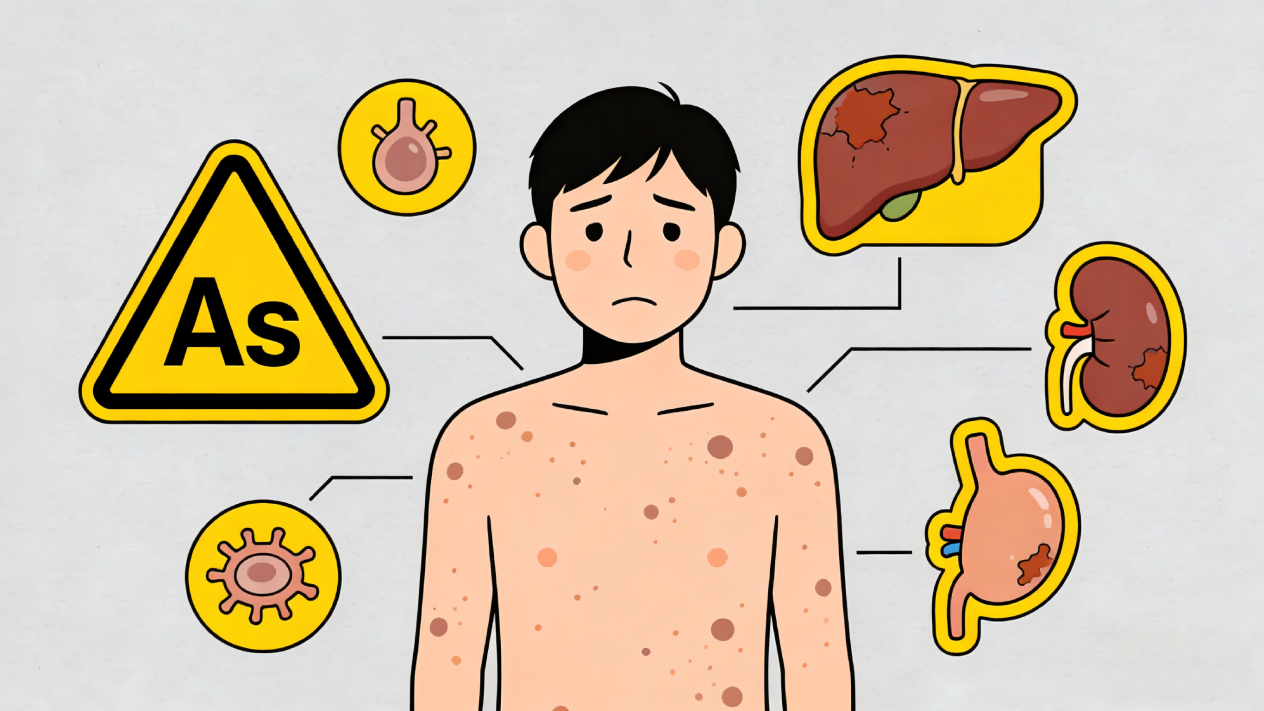
Arsenic — this metalloid element widely existing in nature, once ingested by the human body through drinking water over a long period, can cause irreversible and severe harm to health, even threatening life safety.
I. Understanding Arsenic: An "Invisible and Highly Toxic" Metalloid Element
Arsenic (As), chemical symbol As, atomic number 33, belongs to Group VA metalloids in the periodic table. In nature, it exists in gray, yellow, and black allotropic forms, with gray arsenic being the most common and stable. People often associate it with arsenic trioxide (arsenic frost); however, arsenic frost is actually the arsenic compound arsenic trioxide (As₂O₃). Elemental arsenic has relatively low toxicity, but its inorganic compounds (especially trivalent arsenic and pentavalent arsenic) are extremely toxic and are internationally recognized as Group 1 carcinogens.

Arsenic is widely distributed in nature, with an average content of about 1.5-2 mg/kg in the Earth's crust. It exists in rocks, soil, water bodies, and the atmosphere, mainly sourced from arsenic-containing minerals such as arsenopyrite, realgar, and orpiment. Arsenic can migrate and transform in the environment through natural processes and human activities, thereby entering the drinking water system and posing health hazards.
Arsenic in water is mainly divided into inorganic arsenic and organic arsenic, with inorganic arsenic being far more toxic than organic arsenic. Inorganic arsenic primarily exists as trivalent arsenic (As³⁺, arsenite) and pentavalent arsenic (As⁵⁺, arsenate). The toxicity of trivalent arsenic is about 60 times that of pentavalent arsenic, and it is more difficult to remove, making it the main source of hazard in drinking water arsenic pollution. Organic arsenic mostly exists in seafood (such as arsenobetaine and arsenocholine), has low toxicity, and is easily excreted by the human body, posing a smaller health threat.
Arsenic is hidden; it is colorless, tasteless, and odorless. Once dissolved in water, it cannot be distinguished by the naked eye and requires professional testing to determine if the content exceeds standards. This is also why its pollution is difficult to detect in time. According to data, there are over 3,000 key monitored arsenic-related enterprises globally, and the historical accumulation of arsenic slag reaches tens of millions of tons, further increasing the risk of arsenic entering the drinking water system.
II. Why is There Arsenic in Water?
Arsenic in drinking water mainly comes from two categories: natural and anthropogenic sources. Both jointly lead to increased arsenic levels. Groundwater arsenic exceeds standards in at least 70 countries globally, putting 140-220 million people at health risk, with 85%-90% concentrated in South Asia.
(I) Natural Sources: The Dominant Factor in Areas with Severe Groundwater Arsenic Pollution
1.Geological Dissolution: Arsenic-containing minerals decompose through weathering and erosion, dissolving arsenic into various water bodies. In arid and semi-arid regions, arsenic content easily exceeds standards due to groundwater evaporation and concentration (e.g., Bangladesh, Argentina). In some high-arsenic areas, soil arsenic background values exceed 80 mg/kg, far surpassing the global average.
2.Geothermal and Volcanic Activity: Volcanic eruptions and geothermal activities bring arsenic from deep within the crust to the surface. It enters surrounding water bodies along with volcanic ash and geothermal water. Some hot spring waters have high arsenic content and are not suitable for direct use as drinking water.
3.Biological Transformation: Microorganisms can convert inorganic arsenic into organic arsenic or reduce pentavalent arsenic to more toxic trivalent arsenic under anaerobic conditions, exacerbating the hazard.
(II) Anthropogenic Sources: Indirect Impacts in the Process of Industrialization and Urbanization
There are thousands of arsenic-related industrial enterprises globally, with industries like lead-zinc smelting emitting over 10,000 tons of arsenic annually. Anthropogenic pollution is particularly prominent in industrially and agriculturally developed regions.
1.Industrial Pollution: Improper treatment of arsenic-containing waste generated by mining, smelting, chemical industry, and coal-fired power generation can pollute water bodies. In some severely polluted areas, water arsenic concentrations reach 1.2 mg/L, exceeding the WHO safety limit by 24 times.
2.Agricultural Activities: Residues from historically used arsenic-containing pesticides and fertilizers can enter water bodies through soil infiltration and rain leaching. In some agricultural production areas, 8% of soil samples have effective arsenic content above the potential ecological risk threshold.
3.Other Human Activities: Garbage incineration, electronic waste processing, and urban sewage discharge also release arsenic into the environment, polluting drinking water sources.
III. Countries and Regions Globally with High Arsenic Content in Water
Affected by geological, industrial, and agricultural factors, many countries and regions globally face the problem of excessive arsenic in drinking water. South Asia, Southeast Asia, and some countries in the Americas and Africa are the most prominent. Most of these regions have limited economic capabilities and weak arsenic prevention and control abilities.
(I) South Asia: The Most Severely Polluted Region Globally
Affected by delta geology and superimposed industrial and agricultural pollution, the problem is outstanding.
1.Bangladesh: Known as the "Country of Arsenic Poisoning," 97% of the population relies on groundwater. Over 60% of regions have groundwater arsenic content exceeding the WHO limit of 0.01 mg/L (some reaching over 5 mg/L). About 40 million residents are affected, with extremely high incidence rates of chronic arsenic poisoning and related cancers.
2.India: Pollution is concentrated in the Ganges Plain and Delta, with West Bengal being the most severe. About 30 million residents face risks, with arsenic content in some areas reaching 0.5-2 mg/L. Industrial pollution further aggravates the hazard.
3.Pakistan: Pollution is concentrated in Sindh and Punjab provinces, affecting about 10 million residents. Geological factors combined with pesticide abuse and industrial wastewater discharge make rural areas suffer even more.
(II) Southeast Asia: Prominent Issues in Vietnam, Cambodia, and Thailand
Affected by geology and industry.
1.Vietnam: Concentrated in the Red River Delta, arsenic content in some areas reaches 0.1-0.5 mg/L, affecting about 5 million residents. Mining and metallurgical wastewater exacerbates pollution.
2.Cambodia: Concentrated in the Mekong Delta, affecting about 2 million residents. Due to economic backwardness and lack of water purification equipment, cases of arsenic poisoning are increasing year by year.
3.Thailand: Concentrated in the northeast and central regions, arsenic content in some areas reaches 0.05-0.2 mg/L, affecting about 3 million residents. Pesticide use and small-scale industries exacerbate pollution.
(III) Americas: Typical Cases in Argentina, Chile, and the USA
Affected by geology and industrial activities.
1.Argentina: Concentrated in arid and semi-arid regions, arsenic content in some areas reaches 0.1-1 mg/L, affecting about 4 million residents. Mining exacerbates pollution.
2.Chile: Arsenic content is extremely high in northern arid regions (some reaching 0.5-3 mg/L), affecting about 2 million residents. Prevention and control in rural areas are weak.
3.USA: Concentrated in western regions, arsenic content exceeds limits in some areas, affecting about 1 million residents. There are loopholes in prevention and control in remote areas.
(IV) Africa: Prominent Issues in Ghana, Benin, and Mali
Mainly due to geology and economic backwardness.
1.Ghana: Northern and central regions, arsenic content in some areas reaches 0.05-0.2 mg/L, affecting about 3 million residents. Small-scale mining exacerbates pollution.
2.Benin: Southern and central regions, affecting about 1.5 million residents. Pesticide use and domestic sewage exacerbate pollution.
3.Mali: Around the Niger River basin, arsenic content in some areas reaches 0.05-0.15 mg/L, affecting about 2 million residents. Water purification coverage is extremely low.
In addition, some regions in Turkey, Nepal, and other countries also have arsenic pollution, mainly due to natural geological factors with anthropogenic pollution as a secondary factor, making prevention and control difficult.
IV. Harm of Arsenic to the Human Body: The "Invisible Killer" of Chronic Accumulation
The harm of arsenic to the human body is cumulative, hidden, and irreversible. The degree of harm is related to the intake dose, duration, arsenic form, and human health status. Chronic poisoning is the most common. Inorganic arsenic compounds have been listed as Group 1 carcinogens by IARC.
(I) Acute Arsenic Poisoning: Mostly caused by one-time intake of high doses of arsenic (e.g., accidental ingestion of arsenic trioxide). The incubation period is short (minutes to hours), manifesting as nausea, vomiting, and other "cholera-like" symptoms. Severe cases can lead to multiple organ failure and death. A one-time intake of 0.1-0.2 grams of arsenic trioxide can be fatal for adults, while 0.01-0.05 grams will cause obvious poisoning symptoms. The incidence rate is low, but the mortality rate is high.
(II) Chronic Arsenic Poisoning: Long-term intake of low doses of arsenic (mostly through drinking water) is highly hidden and causes irreversible damage. In high-arsenic drinking water areas, residents' urinary arsenic often exceeds the WHO limit of 10 μg/L, and the prevalence of skin keratosis is more than 4 times that of control areas.
Skin Lesions: The most typical symptom, manifesting as pigment abnormalities ("flower skin disease"), hyperkeratosis of palms and soles, Mees' lines on nails, and hair loss.
In severe cases, it develops into precancerous lesions.
Nervous System Damage: Peripheral nerves manifest as numbness and weakness in hands and feet; central nerves manifest as memory decline and cognitive impairment. Long-term intake in children leads to intellectual disability.
Damage to Other Systems: Damages the cardiovascular system (causing hypertension, heart attack, etc.), liver and kidney functions (severely leading to cirrhosis, kidney failure), and significantly increases the risk of skin cancer, bladder cancer, etc. It also damages the reproductive, digestive, and immune systems. Arsenic enrichment in rice also exacerbates intake risks (in some areas, inorganic arsenic content in rice is close to or exceeds standards).
(III) Safe Dosage: The WHO proposes a drinking water arsenic limit of 0.01 mg/L (10 μg/L), which is adopted by the US, Europe, etc. The lower the arsenic content, the better. Some countries adjust based on their own situations but revolve around the core standard. Special groups such as pregnant women and infants have lower tolerance and require strict control of drinking water arsenic content.
V. Three Mainstream Arsenic Removal Solutions
(I) Arsenic Removal Resins: Precise Targeted Arsenic Removal, Adaptable to Specific Water Quality Scenarios
Arsenic removal resins are mainly divided into chelating type and anion exchange type. They function based on iron-loaded chelating resins or strong base anion exchange resins (quaternary ammonium Type I functional groups). The core of their arsenic removal lies in ion exchange or chelation reactions, making them highly targeted precision arsenic removal materials. The specific surface area of such resins is typically 10~50 m²/g. Adsorption sites mainly rely on their own functional groups, and surface charge can be adjusted according to the resin type—anion resins are negatively charged at neutral pH, while chelating resins can flexibly adjust charge properties.
In terms of arsenic removal performance, arsenic removal resins achieve over 99% efficiency for pentavalent arsenic (As(V)), with an adsorption capacity of about 0.5~3 g/kg (based on resin). The removal effect on trivalent arsenic (As(III)) varies by resin type: anion resins require pre-oxidation treatment, otherwise efficiency is below 60%, while chelating resins can achieve over 90% removal rate without pre-oxidation. Effluent arsenic concentration can be stably controlled below 10 μg/L, with some scenarios achieving deep arsenic removal below 5 μg/L.
The advantages of this solution include high mechanical strength (abrasion rate < 0.5%), strong resistance to backwash loss, and good regeneration performance. They can be regenerated and reused 3~5 times using NaCl/NaOH solutions, with a service life of 2~4 years. They are suitable for scenarios with higher influent arsenic concentrations (≤3 mg/L). Limitations include weak anti-interference capability; high concentrations of sulfate (>500 mg/L) and bicarbonate (>300 mg/L) compete with arsenic ions for exchange sites, requiring pre-treatment removal. Additionally, operation and maintenance (O&M) difficulty is high, requiring specialized personnel for regeneration processes. The generated regeneration wastewater must be treated to meet standards before discharge, and they are prone to organic fouling, requiring regular backwashing and acid washing maintenance.
(II) Iron-Based Arsenic Removal Filter Media (Iron Hydroxide/Iron Oxyhydroxide):
Broad-Spectrum and High-Efficiency, Adaptable to Complex Water Quality
Iron-based arsenic removal filter media use iron oxyhydroxide (α/β-FeOOH/Fe(OH)₃) as the core component. They are currently the mainstream adsorption material in the field of drinking water arsenic removal. Their core advantage lies in a large specific surface area (300~350 m²/g) and abundant hydroxyl active sites on the surface. They carry a positive charge in neutral pH (5~8.2) environments, perfectly adapting to the pH range of natural groundwater. They have excellent temperature resistance, adapting to groundwater temperature fluctuations of 5~40℃.
In terms of arsenic removal performance, this media achieves over 99.5% efficiency for pentavalent arsenic, with an adsorption capacity far higher than arsenic removal resins, about 6~14 g/kg (based on media). It possesses catalytic oxidation capability for trivalent arsenic, achieving over 95% removal rate without additional pre-oxidation treatment. Effluent arsenic concentration can be stably maintained below 10 μg/L, often achieving precise control below 2 μg/L. Its adsorption mechanism combines oxidation-complexation synergy with electrostatic attraction, where arsenic ions form inner-sphere bidentate binuclear complexes with hydroxyl groups on the media surface, resulting in more stable binding.
Compared to arsenic removal resins, iron-based arsenic removal filter media have extremely strong anti-interference capabilities. Common anions in groundwater such as sulfate, chloride, and bicarbonate basically do not affect their arsenic removal effect, requiring no additional pre-treatment. They also possess broad-spectrum heavy metal removal capabilities, simultaneously removing lead, cadmium, chromium, mercury, and other heavy metals, adapting to complex groundwater scenarios near mining areas and farmlands. O&M is extremely simple, requiring no specialized personnel on duty. Only regular water backwashing (once every 15~60 days) is needed, with no chemical consumption or regeneration wastewater generation. Saturated media can be directly replaced, with a replacement cycle of 1.5~5 years. Saturated media can be solidified for landfill or recycled for iron, resulting in low disposal costs. Their mechanical strength is medium-high (abrasion rate 0.5%~1.0%), with high-quality products controllable below 0.8%. Bulk density is 1000-1300 g/L, classifying them as light filter media, easy for backwashing operations.
(III) Reverse Osmosis Method: High-Efficiency Removal of All Arsenic Forms, Adaptable to All Scenario Needs
Unlike the two adsorption-based solutions above, the Reverse Osmosis (RO) method relies on a reverse osmosis membrane with a pore size of only 0.0001 microns. It achieves arsenic removal through high-pressure screening, without relying on adsorption or ion exchange reactions. It can directly intercept all forms of arsenic in water (whether As(V) or As(III)) without additional pre-oxidation treatment. It is currently the solution with the most stable arsenic removal efficiency and the widest adaptability.
The arsenic removal efficiency of this solution can reach 95%~99% or higher. It can stably treat water bodies with influent arsenic concentrations from 0.01 mg/L to 5 mg/L and above to below 10 μg/L, even meeting deep arsenic removal requirements. Simultaneously, it can remove heavy metals, salts, bacteria, viruses, and other impurities in the water. The purified water quality is excellent and can be directly consumed or used for industrial production. Its advantages include a high degree of automation, simple operation, and the ability to achieve continuous stable operation, adapting to various scenarios such as households, industries, and centralized water supply. Limitations include higher initial equipment investment, electricity consumption during operation, and the generation of 30%~50% concentrated water, which needs to be treated for discharge or recycling. Additionally, reverse osmosis membranes need to be replaced every 1~2 years, making long-term operating costs higher than adsorption-based solutions.
(IV) Multi-Dimensional Quantitative + Qualitative Comparison of Arsenic Removal Solutions
| Dimension | Arsenic Removal Resin | Iron-Based Filter Media | Reverse Osmosis (RO) |
| Core Principle | Ion Exchange / Chelation | Oxidation-Complexation + Adsorption | High-Pressure Membrane Screening |
| Specific Surface Area | 10~50 m²/g | 300~350 m²/g | N/A (Depends on pore size) |
| As(V) Efficiency | >99% (Cap: 0.5~3 g/kg) | >99.5% (Cap: 6~14 g/kg) | 95%~99%+ |
| As(III) Efficiency | <60% (Needs pre-oxidation)* | >95% (No pre-oxidation needed) | 95%~99%+ (No pre-oxidation) |
| Effluent Quality | Stable <10 μg/L | Stable <2~10 μg/L | Stable <10 μg/L (Deep removal) |
| Anti-Interference | Weak (Affected by SO₄²⁻, HCO₃⁻) | Strong (Resists common anions) | Strong (Unaffected by ions) |
| Synergistic Removal | Low (Targeted for As) | High (Removes Pb, Cd, Cr, etc.) | Highest (Removes all impurities) |
| Material Cost | $6,500 ~ $11,600 /ton | $2,900 ~ $3,800 /ton | High (Membrane modules) |
| Cost per Ton Water | $0.07 ~ $0.44 | $0.01 ~ $0.04 | Higher (Energy + Membrane replacement) |
| O&M Difficulty | High (Needs pros, regeneration) | Low (Unattended, simple replace) | Medium (Auto, membrane change) |
| Best Application | High As, Low Anions, Small Scale | Complex Water, Large Scale, Retrofit | Household, Ultra-pure needs |
(V) Core Selection Principles
Prioritize Influent Water Quality: For low-arsenic, low-anion scenarios, prioritize iron-based arsenic removal filter media for low cost per ton of water and simple O&M. For high-arsenic, low-anion scenarios, choose arsenic removal resins, as their regeneration performance is more suitable for treating high-arsenic water bodies above 3 mg/L. For high-arsenic, high-anion, or multi-heavy metal coexistence scenarios, prioritize iron-based arsenic removal filter media to purify multiple pollutants simultaneously. For low-arsenic, high-anion scenarios, iron-based arsenic removal filter media offer higher cost-performance and more stable treatment effects.
Secondly Consider Effluent Requirements: If ultra-deep arsenic removal is required (effluent arsenic <5μg/L), prioritize iron-based arsenic removal filter media. If only meeting conventional national standard requirements (effluent arsenic <10μg/L) is needed, all three solutions are viable; choose based on specific water quality. If simultaneous removal of other impurities (such as bacteria, viruses) is required, prioritize the reverse osmosis method.
Combine Engineering Scale and O&M Capabilities: For small water supply scenarios with professional O&M personnel, choose arsenic removal resins or iron-based arsenic removal filter media. For medium-large scenarios (e.g., township water plants, municipal water supply) without professional O&M personnel, iron-based arsenic removal filter media are mandatory to adapt to unattended needs. For household scenarios, prioritize the reverse osmosis method for simple operation and better water quality assurance.
Consider Retrofit Projects and Budget: For retrofitting existing water plant filter pools, iron-based arsenic removal filter media are mandatory; they can directly replace original filter media with low cost and high adaptability. For small-to-medium groundwater arsenic removal equipment, prioritize iron-based arsenic removal filter media for high cost-performance and basic maintenance-free operation. For new small water supply systems with sufficient budget, choose arsenic removal resins or iron-based media based on water quality or actual needs; for high-end demands, choose the reverse osmosis method.
VI. How to Ensure Household Drinking Water Safety?
The core of arsenic prevention and control for household drinking water is "Test First, Choose the Right Equipment, Strong Maintenance." Combining the characteristics of the three arsenic removal solutions mentioned above, and considering the core needs of household scenarios (small water usage, limited O&M capabilities, pursuit of convenience and safety), priority should be given to solutions that are simple to operate, thoroughly remove arsenic, and require no professional O&M.
1.Prioritize Arsenic Removal Equipment Suitable for Households: Considering household scenario characteristics, Reverse Osmosis (RO) water purifiers are the preferred solution for household arsenic removal. Compared to arsenic removal resins (complex O&M, requires specialized personnel for regeneration) and iron-based arsenic removal filter media (limited adaptability for small household equipment), RO water purifiers require no additional pre-treatment. They can directly remove all forms of arsenic in water, with stable arsenic removal efficiency of 95%~99% or higher. Simultaneously, they can remove heavy metals, bacteria, viruses, and other impurities. The purified water quality is safe for direct drinking, fully adapting to daily household drinking water needs. Household RO water purifiers are compact, easy to install, and operate automatically without specialized personnel on duty. They only require regular filter replacement (RO membrane every 1~2 years, front-stage PP cotton and activated carbon filters every 3~6 months), aligning with household O&M capabilities.
2.Alternative Solutions for Special Scenarios: If a household has no power supply conditions (e.g., remote rural areas), small household iron-based arsenic removal filter media filters can be chosen. These devices require no electricity, are simple to operate, and only need regular backwashing (once every 1~2 months) and media replacement (once every 1~2 years). They can meet household drinking water arsenic removal needs for low-concentration arsenic pollution (≤1 mg/L). Note that if trivalent arsenic accounts for a high proportion in home drinking water, no additional oxidation treatment is needed; iron-based media can catalytically oxidize trivalent arsenic themselves to ensure arsenic removal effects.
3.Avoid Ineffective Equipment: Household scenarios must avoid water purifiers containing only PP cotton, ordinary activated carbon, or ultrafiltration membranes. These devices cannot effectively remove arsenic and may even cause secondary pollution due to arsenic desorption after filter saturation. Household devices using arsenic removal resins are not recommended for ordinary families due to complex O&M and the need for regular regeneration; they are only suitable for special households with professional O&M capabilities.
4.Perform Daily Testing and Maintenance: Regularly test the arsenic content of home drinking water, at least once a year. If residing in geologically high-arsenic areas or regions with frequent industrial and agricultural activities, test every 6 months. You can choose household arsenic rapid test kits (convenient and low-cost) or entrust third-party testing agencies (accurate and authoritative). Simultaneously, perform daily maintenance of the water purifier, regularly replace filters, and clean the equipment. Avoid drinking directly after long periods of non-use; drain stagnant water in the pipeline (1~2 minutes) before each use to ensure continuous and stable arsenic removal effects.
5.Source Risk Avoidance: If using groundwater (well water) as drinking water, test the arsenic content first and use it only after confirming it meets standards. Avoid using groundwater directly to irrigate vegetables and crops to prevent indirect arsenic intake through the food chain. Do not use arsenic-containing pesticides or fertilizers to reduce the impact of surrounding environmental arsenic pollution on drinking water.
VII. UMEK's One-Stop Solution
As a one-stop water treatment supplier with 29 years of industry experience and 17 years of foreign trade experience, UMEK relies on mature technology R&D, manufacturing, and global service capabilities. Addressing arsenic pollution prevention and control needs in different scenarios (household and industrial), UMEK provides customized, full-process one-stop solutions. These solutions balance convenience, stability, and compliance, adapting to water quality characteristics and usage needs in different regions globally.
1.Household: Focusing on the core needs of household drinking water arsenic prevention and control, UMEK provides a full series of highly adaptable and easy-to-maintain arsenic removal water purification equipment. The flagship product is the UMEK 600G High-Flow Reverse Osmosis (RO) Water Purifier (Model UMK-80). It adopts a PCB composite filter + RO filtration process, with stable arsenic removal efficiency of 95%~99% or higher. It simultaneously removes heavy metals, bacteria, and other impurities. The effluent meets the WHO arsenic limit standard of 0.01 mg/L and supports direct drinking. The device features a tankless design and automatic operation, equipped with self-cleaning, TDS monitoring, and filter life reminder functions. The flow rate reaches over 1.5 L/min, adapting to various installation scenarios such as under-kitchen counters and wall mounting. It requires no professional O&M, only regular filter replacement (RO membrane every 2 years, front-stage PCB composite filter every 6-12 months). It also comes with a 1-year quality assurance.
2.Industrial: Targeting arsenic-related industrial scenarios such as mining, non-ferrous metal smelting, chemical industry, and coal-fired power generation, UMEK provides a full-process one-stop arsenic removal solution ranging from water quality testing, scheme design, equipment customization, installation and commissioning, to later-stage O&M. It corely adapts to the purification treatment of industrial high-concentration arsenic-polluted wastewater, production water, and circulating water. Relying on deep arsenic removal processes, it adopts customized process routes such as "Pre-oxidation + Modified Media Filtration," "Pre-oxidation + Strong Base Anion Exchange Resin," and "Pre-oxidation + Ultrafiltration/Reverse Osmosis (RO) Combination." Based on industrial raw water arsenic concentration (0.02 mg/L ~ 3 mg/L or above), effluent requirements (≤0.01 mg/L or lower), and production scale, exclusive equipment and treatment processes are customized to ensure effluent meets discharge standards or is recycled, while avoiding secondary pollution risks. The equipment features stable operation, high treatment efficiency, and convenient O&M, adapting to both small-to-medium workshops and large factories. Simultaneously, UMEK provides long-term services including professional O&M guidance, consumable replacement, and equipment maintenance, helping enterprises solve arsenic pollution compliance challenges while balancing environmental requirements and production efficiency. Leveraging 17 years of foreign trade experience, UMEK can adapt to environmental standards of different countries globally, providing multi-language services and rapid response support.
VIII. Conclusion
Although arsenic pollution in drinking water is hidden, it concerns everyone's health baseline. Whether for daily household consumption or industrial production water, safeguarding drinking water safety does not require complex operations. By attaching importance to source control, performing basic testing, and implementing scientific protection, the potential risks of arsenic can be effectively resisted. May every glass of water be pure and safe, letting safety and health accompany every moment of life.